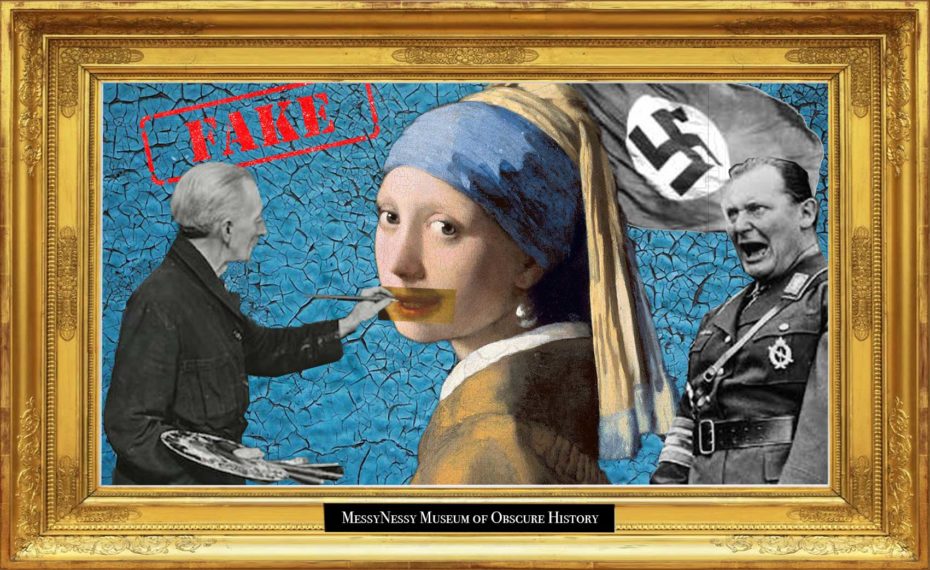
The accepted number of authenticated Vermeer paintings today is 34, but that number became mysteriously higher during World War II. Hermann Göring himself, a leader of the Nazi party and notorious art looter, traded 137 of his prized stolen paintings for a newly-discovered Vermeer, one of several 17th century works that had suddenly emerged in the years leading up to the war. When Göring was facing trial for war crimes, he was informed that his “Vermeer” was actually a fake, and according to an account “[Göring] looked as if for the first time he had discovered there was evil in the world.” As for the master forger behind the painting and at least 18 others fakes, he would become a national hero after admitting his secret to the world. The painter was so good at forging the great masters that he narrowly escaped the death penalty in a sensational trial to prove his innocence as a Nazi art plunderer of cultural treasures. His fascinating career as one of the most ingenious art counterfeiters of the 20th century is a Hollywood script-writer’s dream…

The Supper of Emmaus
“What we have here,” said leading art expert and most eminent authenticator of 17th century Dutch art at the time, “is the masterpiece of Johannes Vermeer.” Abraham Bredius was referring to The Supper of Emmaus (pictured above), and spoke to the international press in 1937 about the “wonderful moment” of being confronted with an unknown 17th century painting by a great master. Unbeknownst to Bredius and the art world, the painting had been intentionally created in the style of Vermeer that very year by a little-known portrait painter, Han van Meegeren. With war looming and the pressure to keep national treasures from being sold overseas, the painting was hurriedly purchased by The Rembrandt Society through Van Meegeren’s lawyer. A wealthy shipowner helped coming up with the funds for its acquisition; equivalent to over €4.6 million today.

Van Meegeren’s own legitimate work prior to the forgery, had been dismissed and rejected by the art world. He had developed an enthusiasm for the paintings of the Dutch Golden Age as a child, but his earlier career creating works in the style of the Old Masters drew the reproach of art critics who branded him as a mere copycat of other artist’s work. This motivated Van Meegeren to invent the perfect forgery and prove to himself that not only was he just as good as Vermeer and his contemporaries, but that the art community had no authority to judge him or his work. (To compensate his bruised ego, he also bought a huge mansion in the south of France with the money from his first forgery, and filled it with paintings by the Old Masters).

In the years leading up to his career as a master forger, Han had immersed himself in the world of a 17th century artist, studying the lives of the greatest Dutch painters, their trademark techniques and their old paint formulas. He purchased antique canvases and re-created his own badger-hair paintbrushes that Vermeer was known to have used. After a painting was complete, Han used Bakelite to make the paints harden before baking his works in the oven and then rolling them over a cylinder and washing the cracks in black ink to give them the illusion of being 300 year-old works of art. It took him six years before he felt ready to fool the art world’s greatest authorities.

Van Meegeren painted some of his best forgeries from his French mansion, where he lived with his wife in luxury, signing them as Venmeer, Pieter de Hooch and other Dutch masters. He returned to the Netherlands a rich man as World War II broke out, buying up mansions along the canals of Amsterdam as critics and museum curators continued to take the bait, marvelling at his forgeries as “newly discovered” Vermeers.

In May of 1940, the Netherlands was invaded by Nazi Germany and sure enough, one his fake Vermeers ended up in the possession of Hermann Göring, who was highly competitive with the führer himself, Adolph Hitler, in becoming one of the world’s biggest collectors of art– much of which had of course been pillaged around Europe, Russia and from Jewish victims of the Holocaust. Göring had a personal collection of over 1,800 stolen works, but his favourite painter was Vermeer, who had not been particularly well-known until the beginning of the twentieth century, making his works both extremely valuable and rare. Hitler already had two Vermeers.

The painting that eventually fell into Göring’s hands was one of Van Meegeren’s, Christ with the Adulteress, sold to a Nazi banker and art dealer in 1942. It was not even one of Van Meegeren’s best; his health had been declining as he’d become addicted to alcohol and morphine by the age of 53. But as luck would have it, with so much of the world’s art hidden away in protective storage for safekeeping during the war, there was very little genuine work to compare it with and the forgery was sold to the Reichmarschall for the equivalent of $7 million today. The war criminal proudly hung the painting at his residence outside of Berlin and later hid it with the rest of his collection in an Austrian salt mine, before American and allied forces discovered the underground depot of 6,750 stolen artworks in 1945. Van Meegern’s painting was found amongst the loot and the records of sale traced directly back to his lawyer. If it wasn’t for the Nazi penchant for stealing art, Van Meegeren’s paintings could have very well still been fooling the world today in major art museums around the world.

American soldiers handling a fake Vermeer by Van Meegern
When Van Meegern was arrested in the aftermath of the war, accused of selling Dutch cultural property to the Nazis, he was facing charges of treason and the eventual death penalty. At the same time, he had around $30 million stashed away in his wife’s bank account– but going down in history as a convicted Nazi collaborator was a price too dear to pay for his secrets. The trial began in 1947 with Van Meegeren’s confession to major forgery. Revealing the truth to the world, he exclaimed, “The painting in Göring’s hands is not, as you assume, a Vermeer of Delft, but a Van Meegeren! I painted the picture!”

To prove it, Van Meegern painted his last ever forgery in an enclosed room in the presence of court-appointed witnesses and press photographers. It was Jesus among the Doctors in the style of Vermeer, which was later sold at auction for a sizeable amount.

His other forged paintings were brought to the trial, guarded by police at night. The courtroom resembled a museum noted one newsreel at the time. Glasses and jars found in Van Meegeren’s home that appeared in several of the forgeries were brought to court and displayed as evidence.

Also found in his studio was a bottle containing the exact chemical components of the paintings. He was convicted on falsification and fraud charges and sentenced to a year in prison, which he never served. Below is a Dutch newsreel covering his trial in 1947:
By the end of the trial, a Dutch opinion poll placed the master forger as the country’s second most popular person after the Prime Minister, viewed by the public as a cunning people’s hero who had taught both the Nazis and the pompous art elite a lesson. Van Meegeren himself didn’t quite see it the same way and made a statement following the trial: “My triumph as a counterfeiter was my defeat as [a] creative artist.” Before beginning his sentence, during the appeal period he lived as a free man, but his health dramatically declined. He suffered a second fatal heart attack at the age of 58.

In the years leading up to and after his death, the greatest forger of the 20th century was ironically himself forged by copycats. He joked that he would have claimed them as his own if they had been good enough. Van Meegeren’s own son even faked his father’s work, imitating his style, albeit not as well, and falsely signing the paintings with his signature. It’s a story that certainly trumps the Banksy hoo-ha that’s had the art world in a frenzy as of late.

Before we finish up, I’d like to take a brief moment to play casting director and share my list of possible candidates to play the role of Han Van Meegeren in a long-overdue Hollywood adaptation of his story. My top picks are as follows: Mads Mikkelsen, Daniel Day Lewis, Christoph Waltz, Gary Oldman, Ralph Fiennes. And maybe Pierce Brosnan purely because of his role in The Thomas Crown Affair.
And as for the “authentic” Van Meegeren fakes today, here’s a complete list of their known (and unknown) whereabouts today via Wikipedia:
- A counterpart to Laughing Cavalier after Frans Hals (1923) once the subject of a scandal in The Hague in 1923, its present whereabouts is unknown.
- The Happy Smoker after Frans Hals (1923) hangs in the Groninger Museum in the Netherlands
- Man and Woman at a Spinet 1932 (sold to Amsterdam banker, Dr. Fritz Mannheimer)
- Lady reading a letter 1935–1936 (unsold, on display at the Rijksmuseum.)
- Lady playing a lute and looking out the window 1935–1936 (unsold, on display at the Rijksmuseum.)
- Portrait of a Man 1935–1936 in the style of Gerard ter Borch (unsold, on display at the Rijksmuseum.)
- Woman Drinking (version of Malle Babbe) 1935–1936 (unsold, on display at the Rijksmuseum.)
- The Supper at Emmaus, 1936–1937 (sold to the Boymans for 520,000 – 550,000 guldens, about $300,000 or $4 Million today)
- Interior with Drinkers 1937–1938 (sold to D G. van Beuningen for 219,000 – 220,000 guldens about $120,000 or $1.6 million today)
- The Last Supper I, 1938–1939
- Interior with Cardplayers 1938 – 1939 (sold to W. van der Vorm for 219,000 – 220,000 guldens $120,000 or $1.6 million today)
- The Head of Christ, 1940–1941 (sold to D G. van Beuningen for 400,000 – 475,000 guldens about $225,000 or $3.25 million today)
- The Last Supper II, 1940–1942 (sold to D G. van Beuningen for 1,600,000 guldens about $600,000 or $7 million today)
- The Blessing of Jacob 1941–1942 (sold to W. van der Vorm for 1,270,000 guldens about $500,000 or $5.75 million today)
- Christ with the Adulteress 1941–1942 (sold to Hermann Göring for 1,650,000 guldens about $624,000 or $6.75 million today, now in the public collection of Museum de Fundatie
- The Washing of the Feet 1941–1943 (sold to the Netherlands state for 1,250,000 – 1,300,000 guldens about $500,000 or $5.3 million today, on display at the Rijksmuseum.)
- Jesus among the Doctors September 1945 (sold at auction for 3,000 guldens, about $800 or $7,000 today)
- The Procuress given to the Courtauld Institute as a fake in 1960 and confirmed as such by chemical analysis in 2011.

It’s been suggested that this not the complete list and that there are other unidentified Van Meegeren forgeries out there, hanging in art museums around the world. It’s believed a painting called Smiling Girl, hanging in the National Gallery of Art in Washington, similar to Girl with a Pearl Earring and supposedly one of Vermeer’s, could easily have been painted by the forger. The subject’s smile certainly suggests she knows something we don’t…

“The Smiling Girl”, at the National Gallery of Art in Washington
The next time you’re faced with a Vermeer, Pieter de Hooch, or a Gerard ter Borch, ask yourself– is Van Meegeren still fooling us from his grave?